Posts

Cirnozardry (Cohost backup)

Image
  Cirnozardry - Review Cirnozardry  is a freeware DRPG made by doujin developer Morisoba. Released in 2014 and translated by an anonymous 4chan poster in 2022 (really!), it seems to be all but completely unknown in the West. I think that’s a real shame: it’s a solid game with some of the best and most consistent dungeon design I’ve ever seen, easily beating out the vast majority of commercial DRPGs. I always find it hard to put dungeon design into words, but if you’re familiar with the genre, you’ll have experienced games that get it and games that don’t.  Cirnozardry  gets it. Each floor is cohesive yet internally varied, never giving way to cacophony or formula; each floor is big enough to explore and get lost in, but not so large that it becomes a slog or runs out of ideas (hello,  Mary Skelter ). Unlike many DRPGs, including most Wizardry clones, floors are also quite dense: events and treasure chests (usually with good items; eat your heart out, Experience ...

Wizardry Gaiden (Cohost backup)

Image
  I just beat Wizardry Gaiden I's second dungeon for the first time and thought I'd take the opportunity to rave about the game. — Wizardry Gaiden I: Suffering of the Queen (ウィザードリィ外伝I ~女王の受難~), released for Game Boy in 1991 and  fan-translated in 2014 , is an absolutely masterful DRPG. Maybe that isn't a surprise—looking at Mobygames, much of the team, including the director,  had previously worked on NES ports of the original trilogy . Gaiden I's biggest strength is its dungeon design, which compares favorably to every other DRPG I've played, including the first few floors of the original Wizardry. Each floor is not just a different layout but a different  kind  of layout: 1F's apartment complex gives way to 2F's outline of a yet-unenterable fortress, which yields in turn to 3F's long L-shaped monster condo. 4F is a tricky teleporter maze, 5F is a rambling cavern full of dark patches, and 6F is another teleporter maze (OK,). Then a dimensional rift tak...

Phantasy Star

Image
Phantasy Star, Sega 1987, Sega Mk. III / Sega Master System I played this game because it was an early and popular DRPG, but I'm not sure it makes sense to evaluate it as one. It's more like a Dragon Quest II clone with first-person dungeons: much of one's time is spent on the overworlds or in (2D, fully explorable) towns; the dungeons are many and small, not few and labyrinthine; and so on. You could almost call it a spiritual successor to  Ultima 1  given the science-fantasy setting, 3D dungeons paired with a 2D overworld, multiple land vehicles, and corridor-based dungeons, but the turn-based combat makes the comparison feel a bit inapt: it's a JRPG through and through. Combat pits the party of 1-4, initially Alis alone but growing to include Myau, Odin, and Noah, against a group of enemies. Unusually, there's never more than one type  of monster in the group, or even stat variance between monsters of the same type. Battles, therefore, are as simple and unstrateg...

Deep Dungeon Madou Senki: Actually quite shallow

Image
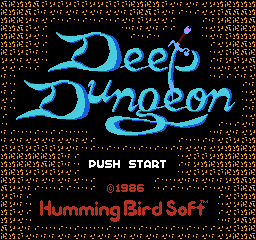
Deep Dungeon Madou Senki /  ディープダンジョン 魔洞戦記,  HummingBirdSoft 1986, Famicom Disk System I first came across Deep Dungeon  as an article in OLD GAMERS HISTORY Vol. 3 , a chronological treatment of early RPGs. It wasn't a particularly glowing review, and it was more focused on the period than on the game itself, but something struck me: as far as I could tell, it was the second turn-based RPG on console, after Dragon Quest , and the first DRPG on console, period. I decided to give it a shot—and, as its ultra-simple combat and lack of gimmicks turned out to hide a surprisingly enjoyable mapping experience, I finished it. The dungeon is about the same size and depth as Wizardry's; its floors are 30x30 to the classic 20x20, but the thick walls really eat into that space. Unfortunately, all that empty space eats into my paper. C'est la vie ; the more important thing is that the floors are, for the most part, open and geometrically interesting, unlike the disguised straight lines...